Avocado Mattress Proves Interactive CTV Ads are Ripe for Growth
Interactive CTV ads have been hyped as “the next big thing” for years. Previewed on conference stages, mocked up in pitch decks, but rarely seen in the wild.
Until now.
Today, those ideas have finally made it onto real TV screens.
As streaming viewership grows and competition for attention intensifies, advertisers are looking for ways to make TV more actionable without giving up scale. Interactive formats like pause ads, shoppable units, overlays, and home-screen takeovers are finally emerging as a practical answer. Not because they’re flashy, but because they meet viewers where they already are.
Why Interactive CTV Ads are Gaining Traction
Traditional streaming ads still do an excellent job building awareness, but they rely on delayed action. Interactive units compress that timeline by inviting viewers to act in the moment, whether that’s browsing products, finding a nearby store, or scanning a QR code; without ever leaving the couch. That’s a plus in my book! And they’re working. These formats are outperforming standard streaming creative for one simple reason: intent. Viewers willingly choose to engage.
Pause ads, in particular, are emerging as a breakout format. They appear when a viewer initiates a break, creating a rare moment of attention with no competing content. Industry analysts describe pause ads as “high-value, low-friction” placements, and the performance backs it up.
According to multiple industry reports, 51% of viewers take action after seeing a pause ad. And with 63% of TV viewers preferring pause ads to frozen screens; something they encounter frequently while pausing content for up to 5 minutes to multitask (i.e. scrolling mindlessly on their phones), brands gain an unusually long window to stay front and center on the biggest screen in the house.
But no matter if it’s a pause ad or one of the other emerging interactive formats, for brands willing to test thoughtfully, these ads are proving they can drive real engagement and deliver meaningful results. Avocado Mattress is a clear example of what happens when the format, creative, and measurement come together.
Avocado Green Mattress: Turning Impressions into Interactions
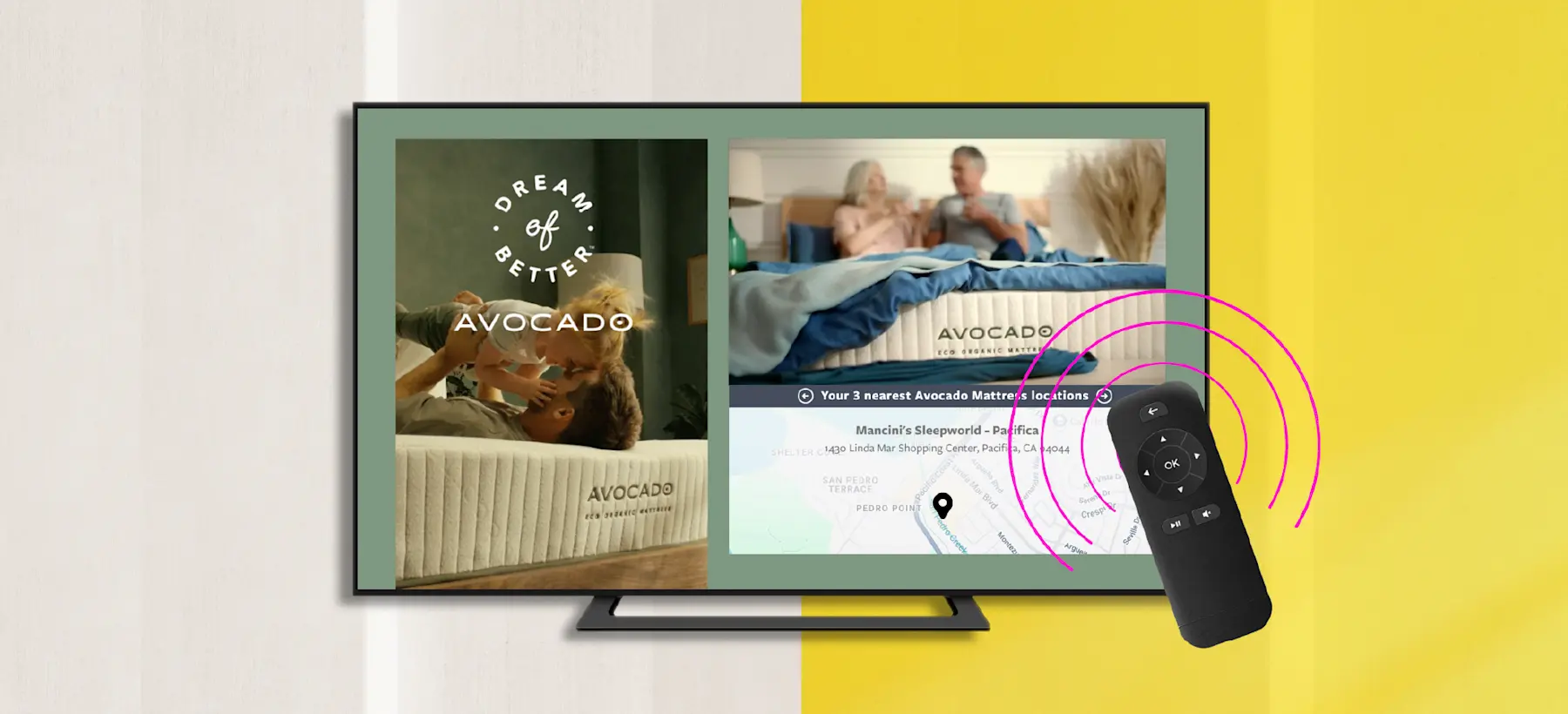
Avocado Mattress partnered with Tatari and Innovid to test an interactive canvas-style action ad built around a simple idea: make it easy for interested viewers to take the next step.
The unit allowed viewers to browse nearby retail locations directly from their TV screen using their remote. No app switching. No disruption. Just a clear, optional action at a moment of attention.
The results were telling.
The campaign delivered millions of impressions, exceeding planned delivery and coming in under budget. Engagement outperformed Innovid's industry benchmark for this particular ad format. Creative testing also revealed that a green background outperformed a white version, a seemingly small detail, but one that reinforces how interactive ads reward intentional creative decisions. Most importantly, the ads drove meaningful foot traffic to Avocado's retail locations, a critical conversion point for customers who want to experience in-person before purchasing.
"Interactive CTV ads helped us bridge the gap between attention and action on TV," said Sidrah Althaus, Vice President of Digital Marketing at Avocado Green Brands. "The results showed that when viewers are invited to engage on their terms, they're willing to do so. With customers wanting to try our organic mattresses in person before purchase, the ads helped drive foot traffic and delivered real results for our stores."
More importantly, the campaign delivered something many advertisers struggle to get from TV: clear engagement signals and actionable creative learnings, not just reach.
What “Interactive” Actually Means on CTV
Interactive ads go beyond pause ads. It’s a growing set of ad experiences, each designed for a different moment, mindset, and objective. Understanding how these formats differ and what they’re best suited for is key to using them effectively. Here’s a quick breakdown of the interactive ad units currently available.
Format | What It Does | Best For |
|---|---|---|
Pause Ads | Appear when viewers pause content, occupying the full screen during a moment of intentional attention | Awareness, mid-funnel engagement, brand recall |
Shoppable & Carousel Ads | Allow viewers to browse products, SKUs, or collections using their remote | E-commerce, retail, shortening the path to purchase |
Overlays & Action Ads | Clickable or tappable elements layered over video content or ads | Performance goals, lead generation, measurable action |
Home-Screen & Title Takeovers | High-impact placements on streaming home screens and menus | Discovery, reach, direct navigation |
Immersive & Expandable Units | Rich, exploratory experiences that invite deeper interaction | Storytelling, high-consideration categories |
The growing adoption of these formats is being supported by clearer standards, including the IAB Tech Lab’s CTV Ad Portfolio, which is helping bring more consistency to creative specs and buying paths.
How Advertisers Should Approach Interactive CTV Ads in 2026
Interactive CTV ads are not meant to be a replacement for standard streaming ads. It’s about pairing reach-driving streaming and linear inventory with the right interactive format for the right job; and treating interactivity as a deliberate layer within a broader TV strategy.
Still, interactive ads come with some friction. Publisher workflows vary, creative requirements aren’t fully standardized, pixel setup is often manual, and most interactive campaigns still run through direct IOs. Programmatic pipes exist, but activation remains limited, and major publishers often require high minimums to execute.
That’s why now is the right time to test. Tatari is investing in faster setup, shared workflows, and same-day measurement reporting to help brands like Avocado Mattress move from one-off experiments to repeatable success.
For advertisers ready to explore what TV can do next, interactive is no longer a gimmick. It’s a practical way to add engagement, insight, and momentum, especially with the right partner guiding the way.

Dana Delle
I'm a strategist at Tatari and love watching TV after my 3 kids go to bed.
Related

Why Sports Is The Fastest Way To Break CTV’s Programmatic Ceiling
Programmatic buying dominates CTV, but it rarely delivers true scale. Here’s why sports-focused direct buying is the game plan brands are using to unlock reach, context, and measurable impact—without blowing budgets.
Read more

How to Budget and Plan for TV in 2026
TV continues to grow as a viable channel for advertisers, earning a larger role in how brands plan, scale, and measure their media investments. This guide breaks down the key TV trends shaping 2026, including a quarter-by-quarter look at the biggest events influencing budget decisions.
Read more

Why Programmatic Buying Alone Isn’t Enough To Win on CTV
CTV ad spend is surging toward $51B by 2029 — and brands relying only on programmatic are missing the biggest opportunities. See how top advertisers are using a hybrid buying strategy to unlock premium reach and full-funnel impact.
Read more